
heattransferequipments.com > products > heat exchangers > cooling towers
HEAT EXCHANGERS & COOLING TOWER MANUFACTURER
Heat Transfer Equipment Pvt Ltd.,
HEAT EXCHANGERS
COOLING TOWERS
Dry Cooling Tower
Heat Transfer Equipments manufactures dry cooling towers for industrial systems where heat needs to be rejected without using water for evaporation. The cooling process relies on air circulation across heat-transfer surfaces, making this configuration useful for facilities where water availability, water conservation, or process-fluid isolation is important.
Dry cooling systems can be designed for different cooling duties and operating conditions. The equipment configuration is selected according to the process fluid, required heat-rejection capacity, ambient temperature, airflow requirements, and available installation space.
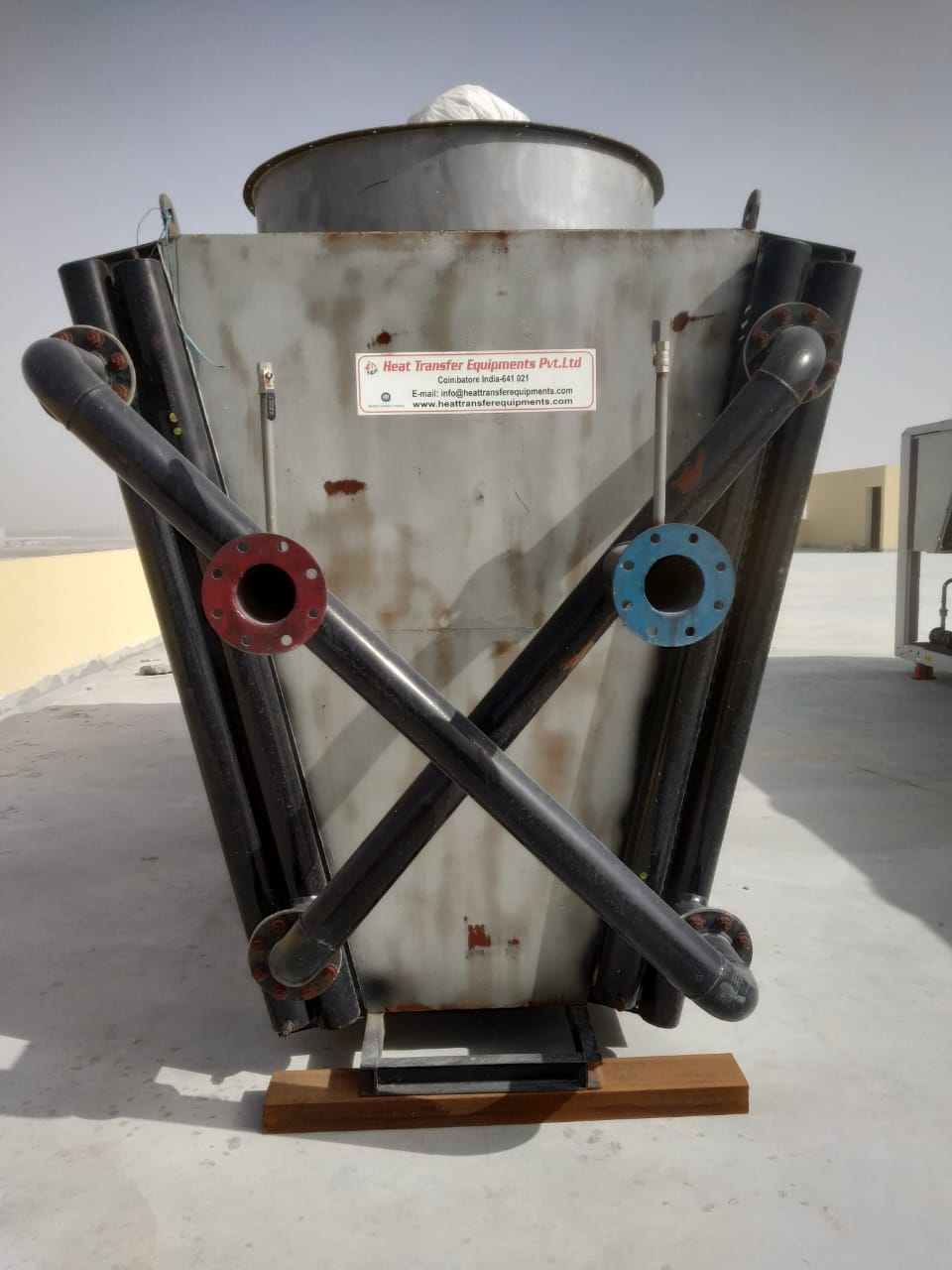
What Is a Dry Cooling Tower?
A dry cooling tower is a heat-rejection system that removes heat from a process fluid through air rather than evaporating water. The working fluid remains separated from the surrounding atmosphere while heat is transferred through a suitable cooling surface.
Because the cooling process does not depend on continuous water evaporation, dry cooling can be considered for locations where water resources are limited or where avoiding water-related contamination is important.
How Does a Dry Cooling Tower Work?
Hot process fluid enters the heat-transfer section of the system and flows through tubes or other suitable cooling surfaces. Fans move ambient air across the external surfaces, allowing heat to pass from the fluid into the air.
Air-Based Heat Rejection
The temperature difference between the process fluid and ambient air drives heat transfer through the cooling surface. The heated air is then discharged from the system while the cooled fluid returns to the process.
Heat Transfer Through Cooling Surfaces
The process fluid remains inside the heat-transfer circuit. This indirect arrangement helps keep the fluid separated from airborne contaminants and eliminates the evaporation losses associated with wet cooling.
Dry Cooling Tower Design & Construction
Dry cooling tower design is based on the required thermal duty and site operating conditions. The heat-transfer surface, airflow arrangement, fan capacity, structural support, and control system are selected according to the application.
Cooling Surface Arrangement
The cooling section can be configured to provide the required heat-transfer area while maintaining suitable fluid velocity and air circulation.
Fan and Airflow Configuration
Fan selection depends on the required airflow, air-side resistance, ambient conditions, and cooling capacity. Proper airflow distribution is important for achieving consistent heat rejection.
Structural Construction
The supporting structure and enclosure are selected according to equipment size, installation conditions, environmental exposure, and maintenance requirements.
Main Components of a Dry Cooling Tower
A typical dry cooling system may include:
- Heat-transfer coils or cooling surfaces
- Axial fans
- Fan motors and drive components
- Structural support
- Air inlet and discharge arrangement
- Process-fluid connections
- Temperature and pressure instrumentation
- Control panel and monitoring system
The exact configuration depends on the process and equipment requirements.
Dry Cooling Technology
Dry cooling uses sensible heat transfer between the process fluid, the heat-transfer surface, and the surrounding air. Unlike evaporative cooling, the system does not require water to evaporate into the air stream for its primary cooling function.
Sensible Heat Transfer
Heat from the process fluid passes through the cooling surface and is carried away by the airflow. Cooling performance therefore depends strongly on ambient air temperature, available heat-transfer area, airflow, and process conditions.
Airflow Management
Balanced airflow across the cooling surfaces helps maintain effective heat rejection. Fan capacity and arrangement are selected according to the required thermal performance and pressure losses.
Industrial Applications
Dry cooling towers can be used across industries where water-free or water-conserving heat rejection is required.
Typical industries include:
- Power Generation
- Steel Manufacturing
- Geothermal Power
- Diesel Power Generation
- Industrial Manufacturing
- Process Industries
The cooling system is selected according to the process duty, operating conditions, and site environment.
Where Dry Cooling Towers Are Used
Power Plant Cooling
Dry cooling systems can be used for heat rejection in power-generation facilities, particularly where water availability is a major consideration.
Compressor and Equipment Cooling
Air compressors and other industrial equipment that require controlled fluid cooling can use dry cooling arrangements suited to their operating conditions.
Process Cooling
Industrial processes requiring removal of heat from circulating fluids can use dry cooling where direct evaporative cooling is not preferred.
Key Benefits of Dry Cooling
Dry cooling towers offer several practical advantages:
- No cooling-water evaporation during normal dry operation
- Reduced dependence on water resources
- Lower risk of process-fluid exposure to atmospheric contaminants
- Suitable for water-scarce locations
- Reduced water-related treatment requirements
- Lower potential for water discharge associated with evaporative cooling
- Useful for applications requiring indirect heat rejection
- Can be engineered for different industrial cooling duties
Actual performance depends on ambient conditions, heat-transfer area, airflow, and process requirements.
Dry Cooling vs. Wet Cooling
Dry and wet cooling systems use different heat-rejection principles.
A dry cooling system transfers heat from the process fluid to air through a heat-transfer surface. A wet cooling system relies on water evaporation to remove heat.
Dry cooling can be advantageous where water conservation or process-fluid isolation is a priority. Wet cooling may provide different thermal performance under certain ambient conditions because evaporation can provide additional cooling.
The appropriate choice depends on cooling duty, climate, water availability, operating cost, and site requirements.
Factors to Consider When Selecting a Dry Cooling Tower
The following parameters should be evaluated before selecting the equipment:
Cooling Capacity
The required heat-rejection load determines the necessary heat-transfer surface and airflow capacity.
Ambient Conditions
Maximum and seasonal ambient temperatures have a direct effect on dry cooling performance.
Process Fluid and Operating Temperature
Fluid type, flow rate, inlet temperature, outlet temperature, pressure, and allowable temperature range should be considered during design.
Installation Space
Available footprint, airflow clearance, equipment height, maintenance access, and connection locations should be evaluated before installation.
Installation Requirements
Correct installation is important for maintaining airflow and equipment performance.
Site Preparation
The foundation or support structure should be suitable for the equipment load and operating conditions.
Airflow and Clearance
Adequate clearance around air intake and discharge areas helps prevent airflow restriction and recirculation of heated air.
Connections, electrical systems, instrumentation, and control components should be installed according to the equipment design and site requirements.
Maintenance and Cleaning
Regular inspection helps maintain cooling performance and equipment reliability.
Fan and Motor Inspection
Fan blades, motors, bearings, drives, and electrical connections should be checked periodically for abnormal vibration, wear, or operating issues.
Coil Cleaning
Dust and debris accumulated on external cooling surfaces can restrict airflow and reduce heat-transfer performance. Cleaning should be carried out according to site conditions.
Performance Monitoring
Process temperatures, fluid flow, fan operation, and pressure conditions should be monitored to identify performance changes at an early stage.
Frequently Asked Questions
What information is required to size a dry cooling tower?
The required cooling capacity, process-fluid flow rate, inlet and outlet temperatures, operating pressure, fluid properties, maximum ambient temperature, and installation conditions are typically required for equipment sizing.
Can dry cooling towers be used for high-temperature applications?
Yes. Dry cooling systems can be designed for high-temperature process cooling by selecting suitable heat-transfer surfaces, materials, airflow capacity, and equipment configuration according to the operating conditions.
Can dry cooling towers operate without cooling water?
Yes. Dry cooling towers transfer heat from the process fluid to ambient air through heat-transfer surfaces, so they do not require continuous water evaporation for normal cooling operation.
Where are dry cooling towers commonly used?
Dry cooling systems can be used in power plants, steel manufacturing, geothermal power facilities, diesel power plants, compressor cooling, and other industrial processes.
What factors affect dry cooling tower performance?
Ambient temperature, process-fluid flow rate, inlet and outlet temperatures, heat-transfer area, airflow, fan capacity, and equipment configuration all influence cooling performance.
Can a dry cooling tower be customized?
Yes. The heat-transfer surface, fan arrangement, materials, structural configuration, controls, and connections can be selected according to the required process conditions and installation requirements.
Is dry cooling suitable for water-scarce locations?
Yes. Since the primary cooling process does not depend on evaporating cooling water, dry cooling can be considered for locations where water availability is limited.
Request a Quote for a Dry Cooling Tower
Looking for a dry cooling tower for an industrial process?
Share your cooling capacity, process-fluid details, flow rate, inlet and outlet temperatures, operating pressure, maximum ambient temperature, and installation requirements with our engineering team.
Heat Transfer Equipments can provide a dry cooling solution based on the required heat-rejection duty, operating conditions, and site requirements.
Contact us to discuss your cooling requirement and receive a customized technical proposal and quotation.