
heattransferequipments.com > products > heat exchangers > cooling towers
HEAT EXCHANGERS & COOLING TOWER MANUFACTURER
Heat Transfer Equipment Pvt Ltd.,
HEAT EXCHANGERS
COOLING TOWERS
Double Pipe Heat Exchanger
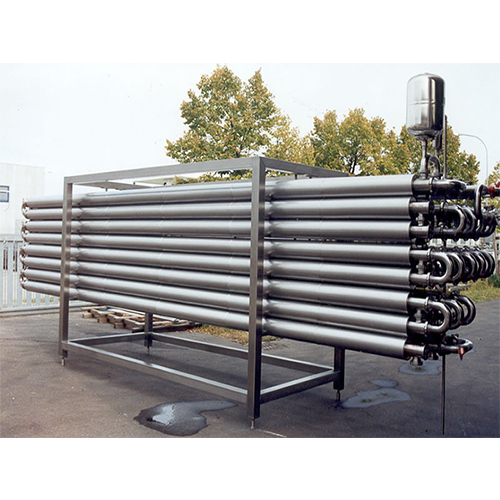
A Double Pipe Heat Exchanger is a compact heat-transfer system in which one pipe is positioned inside a larger outer pipe. One process fluid flows through the inner tube, while the second fluid passes through the annular space between the two pipes. Heat is transferred through the wall separating the two fluids without allowing them to mix.
This simple pipe-in-pipe construction is suitable for heating and cooling duties where reliable heat transfer, straightforward maintenance, and flexible process configurations are required. Double pipe exchangers are also available in hairpin arrangements, where the pipe sections are connected in a U-shaped configuration to provide a practical and compact installation.
What Is a Double Pipe Heat Exchanger?
A double pipe heat exchanger consists of two concentric flow passages. The inner pipe carries one fluid, while the space between the inner and outer pipes carries the second fluid.
The inner pipe wall acts as the heat-transfer surface. Depending on the process requirement, the hotter fluid may transfer heat to the colder fluid for heating, or the colder fluid may remove heat from the hotter stream for cooling.
The design can be configured for counter-flow or parallel-flow operation. Counter-flow is commonly selected when a greater temperature driving force and effective heat recovery are required.
How Does It Work?
The two process fluids enter separate flow paths and remain isolated from each other. As they travel through the exchanger, heat moves through the inner pipe wall from the higher-temperature fluid toward the lower-temperature fluid.
In a counter-flow arrangement, the two fluids move in opposite directions. This maintains a useful temperature difference along the exchanger length and can provide effective thermal performance.
In a parallel-flow arrangement, both fluids enter from the same end and move in the same direction. This configuration may be selected for specific process requirements where the temperature profile or operating conditions make it appropriate.
The required heat-transfer area depends on factors such as fluid temperatures, flow rates, heat-transfer coefficient, and the required heat duty.
Design & Construction
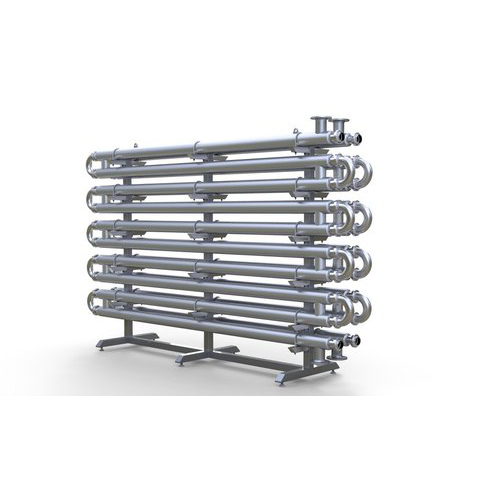
The basic construction is simple, but the exchanger can be engineered in different configurations to suit the process.
Major components generally include:
- Inner heat-transfer tube
- Outer pipe or shell
- Tube-side inlet and outlet connections
- Annular-side inlet and outlet connections
- Return bends
- Hairpin sections, where applicable
- Supports and structural components
- Gaskets and sealing arrangements
- Process nozzles
In a straight double pipe arrangement, the inner tube is positioned concentrically within the outer pipe. For larger duties or compact installations, multiple sections can be connected in series or parallel to achieve the required heat-transfer area and flow conditions. Hairpin configurations use U-shaped return sections and are a common practical arrangement for industrial installations.
Flow Arrangements
Double pipe heat exchangers can operate using two primary flow configurations.
Counter Flow
In counter-flow operation, the hot and cold fluids travel in opposite directions. This arrangement can maintain a more consistent temperature driving force along the heat-transfer length and is often preferred for efficient heating, cooling, and heat-recovery duties.
It can also be useful where the process requires a close temperature approach or significant temperature difference between the inlet and outlet streams.
Parallel Flow
In parallel-flow operation, both fluids enter from the same side and travel in the same direction. The temperature difference is generally highest near the inlet and decreases as the fluids move toward the outlet.
Parallel flow can still be appropriate for selected process duties where the required temperature profile and thermal performance are suitable.
Types of Double Pipe Heat Exchangers
Different configurations can be selected according to the required heat-transfer area, flow rate, pressure conditions, and installation requirements.
Single Tube Double Pipe Exchanger
This configuration uses one inner tube positioned inside the outer pipe. It is a straightforward option for relatively moderate heat-transfer duties and smaller process systems.
Multi-Tube Double Pipe Exchanger
Multiple inner tubes can be incorporated within an outer pipe to increase the available heat-transfer surface. This arrangement can be useful when additional capacity is required while maintaining the basic double-pipe construction.
Hairpin Type Heat Exchanger
A hairpin exchanger uses a U-shaped arrangement in which the pipe assembly returns through a second leg. Multiple hairpin sections can be connected to increase the overall heat-transfer area and accommodate different process requirements.
Countercurrent Double Pipe Heat Exchanger
This configuration is designed for opposite-direction fluid flow and can be particularly useful when efficient heat recovery or a close temperature approach is required.
Materials of Construction
Material selection depends on the process fluids, operating temperature, pressure, corrosion conditions, and required service life.
Common material choices may include:
- Carbon steel
- Stainless steel
- Duplex stainless steel
- Copper and copper alloys
- Alloy steel
- Nickel-based alloys
- Other application-specific materials
Stainless steel may be selected where improved corrosion resistance is required, while copper alloys can be considered for suitable heat-transfer and water-service applications.
The inner and outer flow passages can be specified with different materials when required by the process. Material selection should always be based on fluid compatibility, temperature, pressure, corrosion potential, and applicable design requirements.
Thermal Performance & Efficiency
The thermal performance of a double pipe heat exchanger depends on the available heat-transfer surface, fluid properties, flow velocity, temperature difference, and overall heat-transfer coefficient.
Counter-flow operation can provide a strong temperature driving force along the exchanger length and is therefore often preferred for effective heat recovery and heating or cooling duties.
The design may also be arranged with multiple hairpin sections when additional surface area is required. Flow velocity and pressure drop must be balanced carefully because increasing velocity can improve heat transfer while also increasing hydraulic resistance.
Proper thermal design therefore considers both heat-transfer performance and allowable pressure drop rather than focusing on heat-transfer area alone.
Industrial Applications
Double pipe heat exchangers can be used across many process applications where compact construction and flexible flow arrangements are beneficial.
Typical applications include:
- Oil heating and cooling
- Compressor systems
- Pasteurization systems
- Digester heating
- Heat recovery
- Process pre-heating
- Effluent cooling
- Hydraulic systems
- Chemical process heating and cooling
- High-temperature process streams
- Viscous fluid heating and cooling
- Process fluid temperature control
They can be particularly useful where high pressure, high temperature differences, relatively small flow rates, or moderate heat-transfer duties need to be accommodated.
For suitable applications, the modular nature of hairpin sections also allows the exchanger arrangement to be developed around the required process duty and available installation space.
Key Advantages
A properly designed double pipe heat exchanger can offer several practical benefits:
- Compact and straightforward construction
- Efficient heat transfer for suitable process duties
- Counter-flow operation capability
- Suitable for high-pressure applications
- Can accommodate high temperature differences
- Relatively simple maintenance
- Easy access for cleaning in suitable configurations
- Flexible single-tube and multi-tube arrangements
- Hairpin configurations for compact installation
- Suitable for heating, cooling, and heat-recovery applications
- Low maintenance requirements when correctly selected and operated
Its relatively simple construction also makes it a practical choice for applications where a larger shell-and-tube exchanger may not be necessary. Double pipe designs are commonly considered for moderate heat duties, smaller flow rates, viscous fluids, and services where cleaning access is important.
Design Considerations
Selecting the right double pipe heat exchanger requires evaluation of both thermal and mechanical requirements.
Important parameters include:
- Heat-transfer duty
- Fluid flow rates
- Inlet and outlet temperatures
- Operating pressure
- Design pressure
- Operating temperature
- Allowable pressure drop
- Fluid viscosity
- Fluid density
- Fouling tendency
- Required heat-transfer area
- Pipe dimensions
- Material compatibility
- Flow arrangement
- Installation space
- Cleaning requirements
Pressure drop is especially important when selecting pipe dimensions and flow velocity. A design that provides high heat-transfer performance but creates excessive pressure loss may not be suitable for the process.
For high-pressure services, the pipe-based construction can be advantageous because smaller-diameter pressure-containing components can be designed for demanding operating conditions.
Cleaning & Maintenance
Regular inspection and cleaning help maintain heat-transfer performance and reduce the effects of fouling.
Depending on the service, maintenance activities may include:
- Visual inspection
- Tube-side cleaning
- Annular-side cleaning
- Mechanical cleaning
- Chemical cleaning
- Leak inspection
- Gasket inspection
- Pressure testing
- Checking return bends and connections
- Inspection for corrosion or deposits
One practical advantage of the double pipe arrangement is its relatively straightforward construction. Suitable designs can be dismantled to provide access for cleaning and inspection, which can be particularly useful for dirty or fouling services.
The cleaning method should be selected according to the process fluid, deposit characteristics, tube material, and site maintenance facilities.
Industries Served
Double pipe heat exchangers can be engineered for a broad range of industrial sectors, including:
- Chemical processing
- Petrochemical industries
- Oil and gas
- Pharmaceutical processing
- Food and beverage
- Power generation
- Process industries
- Manufacturing plants
- Water and wastewater systems
- Engineering and utility systems
The final configuration can be customised according to process conditions, heat-transfer requirements, pressure and temperature limits, material selection, and available space.
Frequently Asked Questions :
What is a double pipe heat exchanger used for?
It is used to transfer heat between two separate fluids for heating, cooling, pre-heating, and heat-recovery applications. It is commonly considered for moderate heat duties, smaller flow rates, and applications requiring a relatively simple construction.
What is the difference between counter-flow and parallel-flow operation?
In counter-flow operation, the two fluids move in opposite directions. In parallel flow, both fluids travel in the same direction. Counter-flow generally provides a more favourable temperature driving force for heat transfer.
What is a hairpin heat exchanger?
A hairpin heat exchanger is a U-shaped version of the double pipe arrangement. The pipe sections return through a bend, and multiple hairpin sections can be combined when additional heat-transfer area is required.
Can a double pipe heat exchanger handle high pressure?
Yes. Double pipe designs can be engineered for high-pressure service, subject to the selected pipe dimensions, materials, design pressure, temperature, and applicable engineering standards.
Can it be used for high-temperature applications?
Yes. The exchanger can be designed for elevated temperatures when suitable materials, pressure ratings, thermal expansion provisions, and mechanical design parameters are selected.
What fluids can be used in a double pipe heat exchanger?
Depending on the design, it can handle liquids, gases, oils, water-based fluids, and other process media. Material compatibility, viscosity, fouling tendency, pressure, and temperature must be considered during selection.
Is a double pipe heat exchanger suitable for viscous fluids?
Yes. The annular flow passage can be designed to provide suitable fluid velocity and heat-transfer conditions, making double pipe or hairpin configurations useful for certain viscous-fluid applications.
What information is needed to design a double pipe heat exchanger?
Important information includes the fluid names, flow rates, inlet and outlet temperatures, operating and design pressures, allowable pressure drop, fluid properties, fouling characteristics, material requirements, and available installation space.
Request a Quote for a Double Pipe Heat Exchanger
Looking for a double pipe heat exchanger designed for your specific process requirement? Share your fluid details, flow rates, operating temperatures, pressure conditions, heat-transfer duty, and material preferences with our engineering team.
We can evaluate the process requirements and develop a suitable configuration for heating, cooling, heat recovery, pre-heating, or other industrial heat-transfer applications.
Contact us to discuss your requirement and receive a customised technical proposal and quotation.